
Internal outstaffing: when spin-off works and when shared services do
The company has grown and the back office lives its own life. A spin-off builds a separate company that eventually finds its own clients; shared services build an internal centre for the group only. How this is structured in Ukraine and where the requalification risks are.

The company has grown so much that accounting, HR, IT and transport live their own lives, while the CEO spends half of the working day on people who do not produce the product at all. Two instruments solve this problem differently: a spin-off builds a separate company that eventually looks for its own clients, while shared services build an internal centre that serves the group only.
Key points in 30 seconds
- A spin-off moves a function into a separate legal entity, often with the ambition to reach the external market (serving third parties). Shared services are an internal service centre working only for group companies.
- In Ukrainian practice this is almost never a formal reorganisation. It is a simple incorporation of a new LLC by the same owner, or even by employees of the existing company, followed by the transfer of assets, staff and the function.
- The legal link between the old and the new company rests on contracts (services, lease, sale of assets) and on employment transfers, although a prior spin-out of a legal entity is also possible.
- Globally, shared services are an established industry known as Global Business Services (GBS). According to the Deloitte 2025 survey, such centres increasingly move from routine transactional operations to strategic business support.
- The main reality test for both structures is the same as in outsourcing: does the new company have its own management, its own assets and, for a spin-off, external clients?
- If the right to work with third parties is written into the new company from day one, this both strengthens its independence and opens the path to turn shared services into a full spin-off.
Why separate a function at all
The request is always the same: management no longer wants, or no longer manages, to run production together with accounting, the legal department, logistics and security. Someone else must be accountable for these functions, with their own head, their own KPIs and their own budget. The only question is where to move them: into a company that will also go to the market, or into a company that will serve the group only.
Spin-off: a separate company with its own market ahead
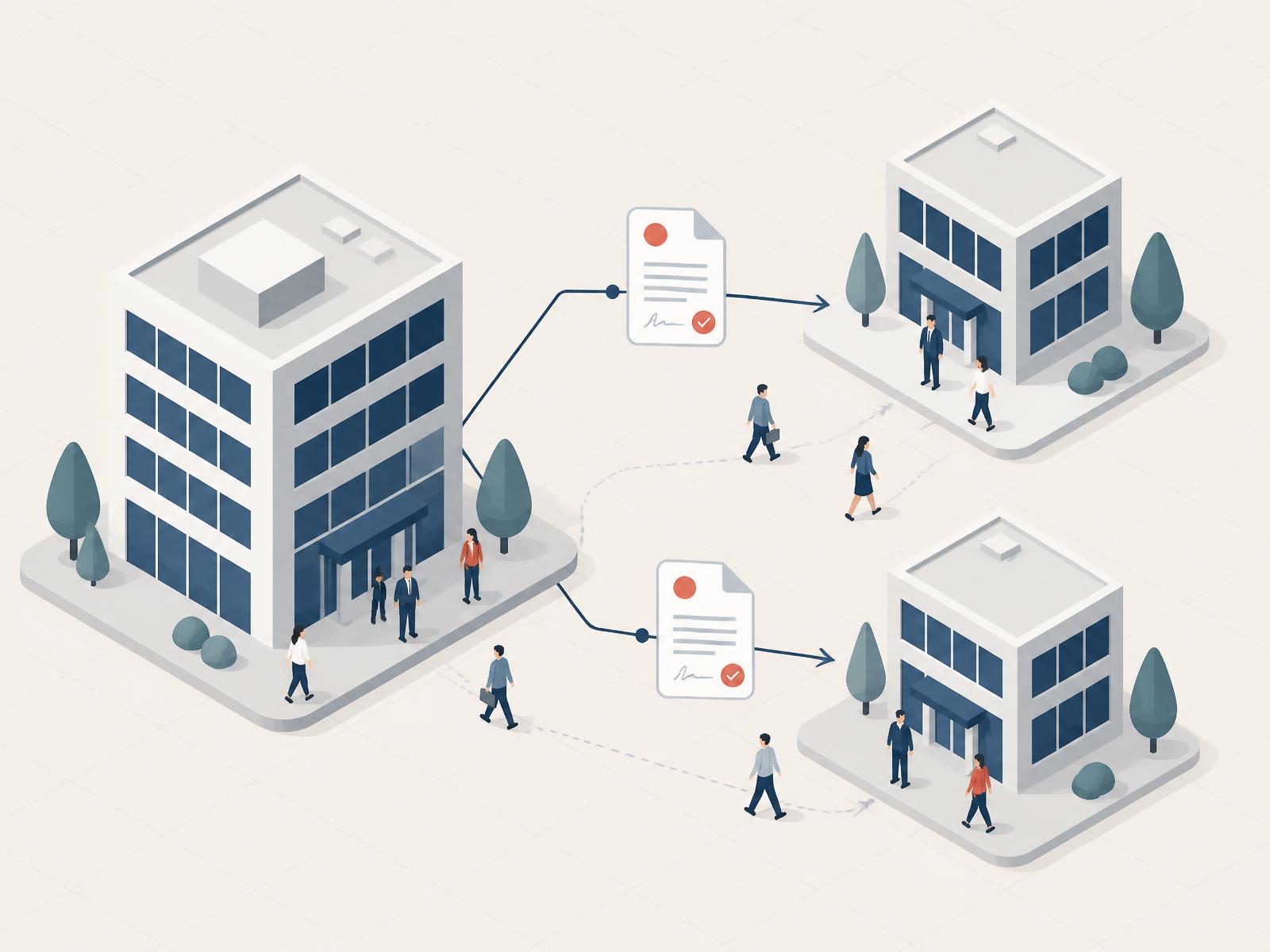
A spin-off is the creation of a new legal entity around a specific function, on the assumption that it will eventually sell that function not only to the parent company but also to external customers. A classic example: a metal structures manufacturer moves its drivers into a separate transport company, and its lawyers and accountants into a legal and accounting firm. At first 100% of the new company's revenue comes from the parent structure. But the goal is for other clients to appear over time.
“A spin-off is the creation of a new legal entity around a specific function, on the assumption that it will eventually sell that function not only to the parent company but also to external customers.”
How it looks in real Ukrainian practice. The formal reorganisation procedure (spin-out, division) is almost never used here. It is cumbersome and rather suited to complex corporate transformations and to resolving tax problems. Instead, the owners of the old company register a new LLC, often with the same or a related set of founders, and fill it with three things: assets, people and the function.
Assets are transferred by contract: a sale, a contribution to the charter capital of the new company, a lease (for vehicles and equipment), or simply a direct purchase of new property by the new company where finances allow. People move through ordinary HR procedures: a transfer with the employee's consent to another employer, or dismissal by way of transfer and hiring by the new company. The function is documented by a services agreement (Chapter 63 of the Civil Code), a carriage agreement (Chapter 64 of the Civil Code) or other contracts between the old and the new company. These contracts become the day-to-day legal framework of the relationship.
Important. Precisely because there is no formal reorganisation, there is no automatic legal succession either. The old company does not hand over its obligations as a package. Every asset, every contract and every employee moves through a separate action. This is both an advantage (no risk of subsidiary or joint liability for old debts, typical of reorganisation procedures) and a drawback: each individual transfer must be documented carefully, otherwise assets or obligations may hang between the companies or be documented improperly.
The new company's right to work with third parties should be built in at registration (activity codes), in the business plan, and in genuine first attempts to find external clients, even small ones. This is not a formality. The presence of, or at least an active search for, an external client is the main evidence that the tax and labour inspectorates are looking at a separate business rather than a facade.
Shared services: an internal centre with no market exposure
Shared services (Global Business Services, GBS) are a similar but slightly different instrument. Here the goal is not to build a new business but to centralise routine work: one centre processes invoices, keeps the books, supports IT and handles HR requests for all group companies at once, instead of each legal entity maintaining its own duplicate department.
The key difference from a spin-off: shared services do not claim the external market. The centre serves only its own group, and this is exactly why it is both the most useful (process standardisation, economies of scale) and the most legally vulnerable: without external clients it is hardest to prove that this is a real business rather than an artificial pocket for shifting costs or staff.
In Ukrainian practice shared services are set up as simply as a spin-off: a new LLC, staff transferred, assets handed over or purchased separately. Legally, relations inside the group rest on the same set of services agreements. The difference lies not in the legal form but in the economic substance and, accordingly, in the risks: without the intention and an attempt to reach the external market, the centre remains structurally exposed to requalification.
How it works globally
Shared services are not a Ukrainian invention but a global industry with decades of practice and an established vocabulary. Since 1999 Deloitte has run the Global Business Services Survey, one of the most authoritative studies in the field. According to the 2025 survey, which covered executives in more than 30 countries, GBS models are becoming more flexible, digital and cost-efficient, improving customer and employee experience and moving such centres to the forefront of business transformation. Researchers separately note the growing role of Global Capability Centers — centres that play a critical role in meeting a company's specialised talent needs rather than only performing routine operations.
A telling trend of recent years is that shared services are ceasing to be a pure back office. According to the SSON industry report for 2026, 52% of organisations are already moving from transactional back-office activity to supporting the core business. That is up from 48% in 2025, and another 34% are actively considering such a shift. Only 14% say this evolution is not on their agenda. The shift has effectively become an industry standard. A modern shared services centre is increasingly not just in-group outsourced accounting but a hub for analytics, strategic planning or even R&D support.
Geography is also indicative. India remains the main hub for advanced GBS functions: among organisations prioritising advanced capabilities, roughly 50% have GBS centres in India, where digital and data competencies are being deployed intensively. At the same time the industry faces the classic risk of outsourcing to low-cost jurisdictions: rising labour costs. Wage inflation in top GBS destinations, notably India, where the BPO industry projected salary increases of 9.7% in 2025 after 9.5% in 2024, systematically erodes the initial cost advantage. It is a reminder that shared services are not a one-off saving but an operating model that must be constantly reassessed.
Legally, in the West spin-offs and shared services are structured almost exactly as in Ukraine: a separate legal entity plus intercompany service agreements. The key difference is far stricter and more consistent scrutiny of transfer pricing between related parties under the arm's length principle, which also underpins Ukrainian transfer pricing rules.
Spin-off and shared services side by side
| Criterion | Spin-off | Shared services |
|---|---|---|
| Purpose | A new standalone business built on the function | Centralising routine work for the group |
| Clients | The parent company plus external customers (the goal) | Group companies only |
| How it is structured in Ukraine | A new LLC plus asset transfer (sale, lease, contribution) plus staff transfer plus services agreements | A new LLC plus services agreements between group companies |
| Legal succession | Usually none. Each asset and obligation is transferred separately, although spin-out or division structures are not excluded | None |
| Main risk | Treated as artificial splitting or a sham where there are no external clients | The easiest to requalify: no external market to prove independence |
| What saves it | Real external customers, own management, own assets, the right to work with third parties written in from the start | Reaching the external market (at which point it effectively becomes a spin-off) |
| Global equivalent | Carve-out, spin-off | Global Business Services (GBS), Global Capability Center |
How to apply this in Ukraine: step by step
When planning to separate a function, work through several steps in order. First define the goal: if the function (accounting, IT, transport) could in theory be sold to external clients and management intends to do so, it is a spin-off candidate. If the function is purely internal, plan for shared services without spending effort on external positioning.
Next, document the transfer of assets by contract: a sale, a lease, a contribution to charter capital and so on, depending on what is more advantageous in tax and operational terms for each specific asset. Record each contract separately, at a market price. There is no universal package transfer here, so vagueness in the documents hits each transaction individually rather than a single balance sheet.
Then ensure genuine managerial independence: the new company must have its own head who takes operational decisions rather than merely signing documents on instruction from the parent. Document employment transfers correctly, either by transfer with the employee's consent or by dismissal and hiring.
Pricing comes next. Where significant amounts are involved, keep prices between related companies at market level even when the transaction is purely domestic and formally falls below the controlled-transaction thresholds (annual income above UAH 150 million and transactions with a counterparty from UAH 10 million, which as a general rule concern mostly transactions with non-residents). The tax authority can still test the business purpose of the transaction under general Tax Code rules.
Finally, for a spin-off, build a realistic path to external clients into the business plan rather than a declaration of intent. An external client is the strongest evidence that the new company is a real business and not a staffing pocket of the old one.
Case study
A regional retail grocery chain had grown its accounting department to more than 30 employees. Management needed not only to streamline the department but also to free up excess office space. The decision was to separate accounting together with other back-office staff into a standalone LLC. Key employees of the department became co-founders of the new company. Over time it began to generate income from serving external businesses. It has been operating for more than ten years.
Frequently asked questions
Is a formal reorganisation required to separate a function into a standalone company?
No, and in practice almost nobody does it. It is enough to incorporate a new LLC and transfer assets, staff and the function to it through separate contracts: sale, lease, contribution to charter capital, employee transfers. Reorganisation by spin-out or division is also possible, but usually when there are other business problems to solve.
Is the new company liable for the old company's debts?
No, because there is no legal succession when a new LLC is simply incorporated. Liability arises only for those specific obligations the new company has expressly assumed by contract.
Can you start as shared services and grow into a spin-off?
Yes, this is common global practice. A centre that served only the group later enters the market and starts selling services to external clients.
What most quickly reveals that a new company is artificial?
A complete absence of external clients combined with non-market prices for services to the group and a single manager who effectively takes decisions for both the old and the new company.
Does the law regulate transfer prices between Ukrainian group companies?
The formal transfer pricing thresholds (UAH 150 million of income and UAH 10 million of transactions with a counterparty) mostly concern transactions with non-residents and low-tax jurisdictions. For purely domestic transactions between related parties these thresholds do not apply automatically, but the tax authority may test business purpose and the market level of prices under general rules.
Read also: Outsourced accounting alongside an in-house accountant.