
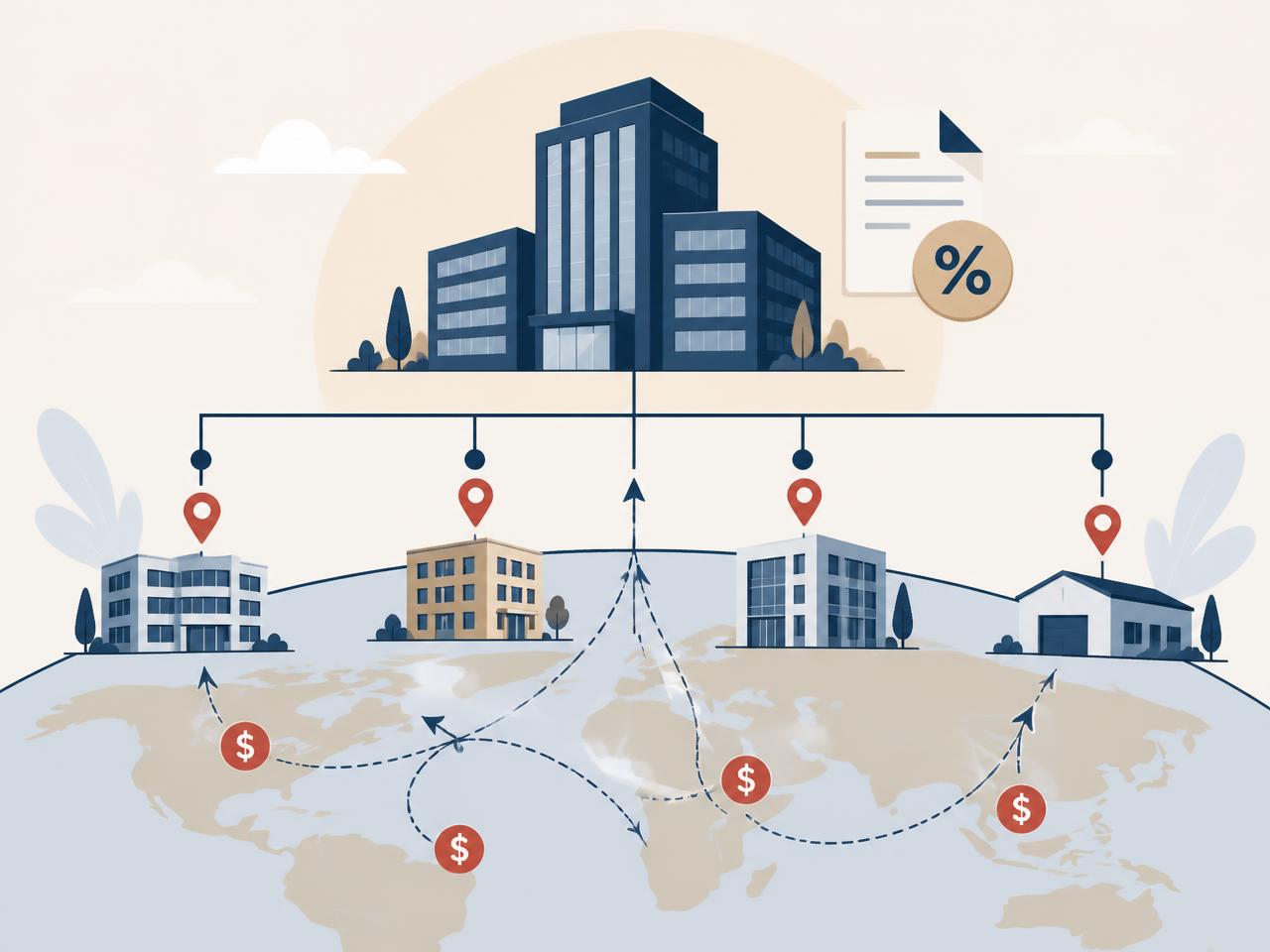
Business splitting: will it survive after 2028? Part II — cross-border structures
The cross-border side of business splitting: the principal purpose test, GAAR after ATAD from 2028, holding structure risks, CFC rules, transfer pricing and thin capitalisation (3.5x equity, 30% EBITDA).

Everything described in Part I concerns mostly domestic Ukrainian realities: splitting into sole traders (FOP), internal asset protection and banking compliance inside the country. As soon as a foreign element appears in the structure — a parent company abroad, a loan from a non-resident, royalty or dividend payments outside Ukraine — a separate set of rules comes into play.
The principal purpose test and GAAR for cross-border transactions
The Principal Purpose Test (PPT) is the only element of GAAR that already works in Ukraine today, and it applies specifically to international transactions. Ukraine has applied the PPT since 1 December 2019 under the Multilateral Convention (MLI). The test allows the authorities to deny benefits under a double tax treaty if obtaining that benefit was one of the principal purposes of the transaction or the structure.
What comes next?
Ukraine has not yet introduced a full-scale GAAR as a separate general rule. Only individual elements exist: the principal purpose test for international transactions and the concept of a "reasonable economic reason (business purpose)" in transfer pricing rules. However, on 24 February 2026 the Ministry of Finance published for public discussion a draft law implementing the ATAD (Anti-Tax Avoidance Directive). That document is meant to introduce a systemic GAAR, with a planned effective date of 1 January 2028.
“Ukraine has not yet introduced a full-scale GAAR as a separate general rule.”
What do GAAR and PPT cover?
In practice the PPT most often affects payments of dividends, interest and royalties to a foreign holding company. The reduced treaty rate is available only if the foreign company is the beneficial owner of the income and has sufficient economic presence (substance): its own office, staff, real management decisions — not just a mailing address. A lack of substance combined with the PPT, and in future with a systemic GAAR after ATAD implementation, may result in a complete denial of treaty benefits and withholding tax charged at the full rate.
The systemic GAAR described in Part I will, once it takes effect on 1 January 2028, apply both to purely domestic transactions and to cross-border ones. But for international structures its practical weight will be greater: this is where the largest tax benefit and the hardest questions of substance and business purpose usually sit. More on this in Business purpose in transactions with non-residents.
Tax risks of holding structures
A holding structure — a parent company plus subsidiaries or operating companies — is lawful in itself and widely used for asset protection, governance, financing and attracting investment. It creates several specific tax risks that must be managed deliberately, and most of them intensify precisely when the parent company is registered abroad.
The highest and most frequent risk is transfer pricing. All intra-group transactions (rent, management services, loans, royalties, sale of goods, secondment of personnel) between related parties are controlled transactions once the value thresholds of the Tax Code are met. Prices and terms must comply with the arm's length principle. Missing or poor-quality transfer pricing documentation leads to penalties and additional corporate income tax. Interest-free or below-market loans, rent at non-market rates and management services without real content or volume are especially dangerous.
Business purpose of intra-group transactions
The tax authority may challenge any transaction inside the group if it considers that the transaction has no economic sense other than a tax one (that is, a tax benefit). Typical claims are:
- the parent company merely "holds" shares and carries out no real activity;
- transactions between group companies are circular or artificial;
- the whole structure was created mainly for tax optimisation.
Controlled foreign companies (CFC)
If the holding includes foreign companies (even in jurisdictions with a normal level of taxation), controlling persons who are Ukrainian residents must file notifications on acquiring participation and annual CFC reports. CFC profit may, under certain conditions, be taxed in Ukraine even without an actual distribution of dividends. Failure to file, or late filing, carries significant penalties.
Withholding tax on repatriation
Dividends, interest and royalties paid to a foreign holding company are subject to a 15% rate or a reduced treaty rate. The reduced rate is available only where there is a beneficial owner of the income and sufficient substance (see the section on the PPT above).
Other risks:
- the thin capitalisation rule;
- a possible finding that the foreign holding creates a permanent establishment in Ukraine where it is actively managed from Ukrainian territory;
- specific taxation on the sale of shares or on liquidation;
- future application of GAAR after full ATAD implementation.
Important. Several actions help reduce the risks of a holding structure. Ensure real substance in each company: an owned or leased office, qualified staff, genuine decision-making and risk-bearing. Set and document market terms for all intra-group agreements. Maintain quality transfer pricing documentation. Clearly record the business purpose behind creating and operating the structure. Avoid "empty" holding companies that perform no function at all. Once every one or two years, run a tax and corporate audit of the structure.
Thin capitalisation risks in Ukraine
The thin capitalisation rule (clause 140.2 of the Tax Code) limits the ability to deduct interest on debt owed to non-residents when calculating the corporate income tax base.
The rule applies where two conditions are met at the same time:
- the taxpayer's debt to all non-residents exceeds equity by 3.5 times or more (the calculation uses the arithmetic mean of debt and equity at the beginning and at the end of the reporting tax period);
- interest has been accrued on such debt.
If the debt-to-equity ratio is 3.5 or higher, interest accrued in the accounts on obligations to non-residents may be deducted only up to 30% of a specially calculated base — a figure close to EBITDA.
EBITDA here means the taxable object with certain adjustments, plus financial expenses, plus depreciation. Interest above that limit increases the pre-tax financial result in the current period. The excess interest may be carried forward to future tax periods, but with an annual reduction of 5% of the amount still unused.
The main risks are:
- part of the interest on loans from foreign lenders, especially from group companies, does not reduce the tax base in the current year;
- calculating average debt and equity, and the base for the 30% limit, is technically demanding;
- interest capitalised into the cost of non-current assets also falls partly under the limit through depreciation.
Loans from related non-residents most often create the problem precisely in holding structures. First the arm's length principle applies to the interest under transfer pricing rules, and only then does the thin capitalisation rule kick in.
The rule does not apply to interest accrued in favour of Ukrainian residents. There are also exceptions for certain categories of taxpayers, in particular financial institutions under certain conditions. If debt to non-residents does not exceed 3.5 times equity, the limit does not operate at all.
How can these risks be reduced?
First. Continuously monitor the debt-to-equity ratio and keep it below 3.5.
Second. Increase equity through additional contributions or capitalisation of profit.
Third. Replace debt financing from non-residents with contributions to share capital, loans from Ukrainian residents or other instruments.
Fourth. Document all calculations carefully and keep support for the market level of the interest rate.
Fifth. Monitor legislative changes, especially ATAD implementation, where a more universal interest limitation at 30% of EBITDA is under discussion — with no link to the 3.5 ratio.
How the risks interact and why they must be seen together
In practice, risks rarely exist in isolation. Thin capitalisation often combines with transfer pricing: interest on loans from related non-residents is first tested against the arm's length principle and only then against the 3.5 and 30% rules. A lack of business purpose strengthens the tax authority's position both in transfer pricing disputes and under the future GAAR or the existing PPT. Banking compliance may react earlier than a tax audit and create operational problems before any assessment is issued.
Risks should therefore be addressed together rather than separately. That means simultaneously ensuring substance, market terms for intra-group transactions, compliance with thin capitalisation, quality documentation and a clearly recorded business purpose.
Practical conclusions and key steps
The state fights artificial splitting aimed at minimising tax — not business structuring as such, whether domestic or cross-border. GAAR, PPT and similar instruments apply only where the tax benefit is the main or one of the main purposes of a transaction or a series of transactions. Where exactly that line runs is examined in Lawful tax saving or evasion.
Purely protective, managerial or investment-driven structuring is lawful and defensible if each element of the structure has a real function and economic autonomy, intra-group transactions are at market terms and properly documented, and the business purpose is clearly recorded in contemporaneous documents.
Preventive protection is the best kind. When you create or change a structure, it is worth assembling the full evidence pack on business purpose right away. If the tax authority raises questions later, the owner will not have to invent arguments.
Key practical steps for a business owner and their team:
- Record the non-tax purpose of the structure in writing at the decision-making stage.
- Ensure genuine economic autonomy for each entity: assets, staff, clients, accounts, liability.
- Set and document market terms for all intra-group transactions.
- Monitor the ratio of debt owed to non-residents against equity.
- Maintain quality transfer pricing documentation where required.
- Run a tax and corporate audit of the structure at least once every one or two years.
- Keep a full chronology of decisions, calculations, correspondence and annexes in a secure and accessible form.
A properly built and well-documented structure combines asset protection, ease of management, investment appeal and an acceptable level of tax risk. A poorly documented structure creates risks of tax assessments, penalties, account blocking and creditor claims — and in extreme cases, criminal exposure. The difference between lawful structuring and artificial unlawful splitting lies not in the external legal form but in real economic substance, the quality of management decisions and the completeness of the evidence base.
Frequently asked questions
How does GAAR differ from the PPT?
The PPT has been in force in Ukraine since 2019 and concerns only benefits under double tax treaties. A systemic GAAR after ATAD implementation (planned for 1 January 2028) will apply far more broadly, including to purely domestic transactions.
Can the thin capitalisation rule be avoided?
The rule is triggered only where debt to non-residents exceeds equity by 3.5 times or more. If you control that ratio or replace part of the debt financing with contributions to capital, the limit does not apply.
What damages a business purpose dispute the most?
Documents drawn up after the tax authority's request or after an audit has started. Courts and tax officials trust after-the-fact explanations far less than evidence created at the same time as the decision to set up the entities.
Does GAAR concern only large business?
No. There is no formal threshold. The criteria of artificiality and absence of business purpose apply to a two-company structure just as much as to a group of dozens of entities.
Related reading
- Business splitting — will it survive after 2028? Part I
- Business purpose in transactions with non-residents
- Lawful tax saving or evasion
Read also: What the Ukrainian tax authority sees in 2026: a full map of STS data sources.
See also: Business splitting among sole proprietors: one Wi-Fi point.