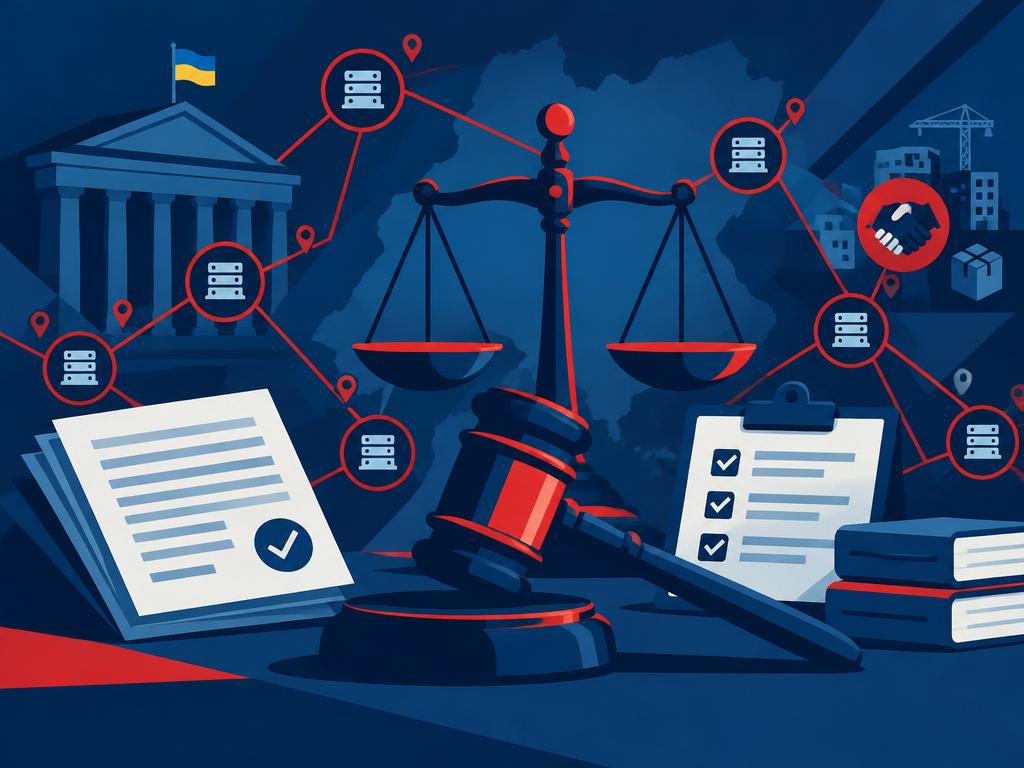

Reporting Corruption in Ukraine: A Practical Guide for Businesses and Citizens
How to recognize corruption, which authority to contact (NACP, NABU, SBI, or the National Police), and what guarantees a whistleblower and an applicant have. A practical guide for company owners and executives based on materials from the NACP.
KBSDC Editorial
Reporting Corruption in Ukraine: A Practical Guide for Businesses and Citizens
Corruption has long ceased to be a problem confined to "government offices." It also arises in the private sector—in relationships between companies, in public procurement, and in the daily interactions of businesses with state and local government authorities. For a company owner or manager, understanding what qualifies as corruption, who to contact and how, and what guarantees are provided to a person reporting a violation is a matter not only of civic duty but also of practical protection for their own business.
Below, we have organized the key rules of the corruption reporting mechanism: from the definition of the concept to submitting a report and appealing the inaction of authorities. This material is prepared in a simplified form and is for informational purposes; it does not replace a direct review of legislation or consultation with a specialist in a specific situation.
What is Corruption: Three Mandatory Elements
Corruption is the use of official powers to obtain an unlawful benefit. Moreover, corrupt acts are committed by both sides: the one demanding or receiving the benefit, and the one providing, promising, or offering it—regardless of whether it is for themselves or for someone else.
“Corruption is the use of official powers to obtain an unlawful benefit.”
Legally, corruption can be reduced to a simple formula in which all three elements must be present simultaneously:
special entity + official powers + unlawful benefit.
A special entity (спеціальний суб'єкт) is a person who performs the functions of the state or local government, as well as persons equated to them. The full list is defined in the Law of Ukraine "On Prevention of Corruption."
Official powers (службові повноваження) are the rights and duties officially granted to a person to carry out the tasks stipulated by their position or official activities: making personnel or production decisions, disposing of state property, etc.
An unlawful benefit (неправомірна вигода) is any material or non-material benefit, including advantages, privileges, and services that are illegally promised, offered, provided, or received. This includes not only classic bribes but also, for example, discounts on goods or career advantages.
The key point: a violation is considered corruption only when all three elements are present simultaneously. If even one is missing, the classification will be different.
Let's illustrate the difference with an example relevant to the construction business. If a company informally pays funds to city council officials to expedite a construction permit, this is corruption: the officials receive a personal benefit without legal grounds, and the company induces them to unlawfully use their powers. However, if the same company pays the city council an additional sum for an expedited permit according to an official price list, this is not corruption—the payment of additional funds is officially provided for, and the parties are acting lawfully.
It is worth emphasizing again: corruption is possible not only in state and local government bodies but also in the private sphere, including business—and it is also subject to liability.
Types of Violations and Liability for Them
Three types of violations are related to corruption, differing in the level of public danger and the nature of liability.
Corrupt offenses — this is corruption proper: actions that have the corresponding elements (official position + unlawful benefit). These are criminal offenses—misappropriation of state property, misuse of budget funds, abuse of power, providing an unlawful benefit to an official, etc. The list of criminal corrupt offenses is provided in the note to Article 45 of the Criminal Code of Ukraine. They can result in criminal, disciplinary, and civil liability. For example: the head of a district education department organized the procurement of equipment for school cafeterias at inflated prices, with an overpayment of over UAH 2 million; the court imposed a sentence of imprisonment with confiscation of property and a ban on holding certain positions.
Corruption-related offenses — actions that do not have the elements of corruption but violate the requirements and restrictions of the Law: for example, restrictions on receiving gifts, holding concurrent positions, or managing a conflict of interest. This is not yet corruption, but a violation of the rules designed to prevent it. Liability can be criminal, administrative, disciplinary, or civil.
Other violations of the Law relate, in particular, to non-compliance with rules of ethical conduct, disclosure of information about a whistleblower, or violation of requirements for organizing anti-corruption work in an institution. If these are detected, the NACP issues an order (припис) to eliminate the violations; the guilty parties are most often subject to disciplinary liability.
Separately, there is a mechanism that does not require mandatory proof of a person's guilt and prosecution for a criminal or administrative offense. Sanctions are applied to unjustified assets (необґрунтовані активи)—those that a person could not have acquired with their official income and whose legal origin they have not confirmed. Their seizure is called civil forfeiture (цивільна конфіскація). For example, if an official purchased a car, registering it in their father's name, and the difference between their legal income and the car's value was UAH 5 million, the court may recognize the vehicle as an unjustified asset and seize it for the state's revenue, after which the official is dismissed from their position.
Who to Contact: Jurisdiction of Authorities
The fight against corruption in Ukraine is primarily handled by specially authorized bodies—the NACP, NABU, National Police, prosecution bodies, and the State Bureau of Investigation (SBI). Choosing the right addressee speeds up the review process, so it is useful to understand their jurisdiction.
NABU investigates specific criminal offenses (abuse of influence, laundering of criminal proceeds, misuse of budget funds, etc.) when at least one of the following conditions is met: the crime was committed by top officials (ministers, members of parliament, judges other than HACC judges, heads of prosecution bodies, heads of category 'A' central executive bodies); it involves large sums (the amount of the unlawful benefit exceeds 500 PM—over UAH 1.6 million in 2026, or the damage caused exceeds 5000 PM—over UAH 16.6 million in 2026); a bribe is offered or given to a person under NABU's jurisdiction.
The SBI investigates criminal corrupt offenses committed by officials of NABU and SAPO, as well as high-ranking officials, law enforcement officers, judges, and military personnel in cases not under NABU's jurisdiction.
The National Police investigates corrupt offenses not under the jurisdiction of NABU and the SBI (including cases of petty corruption) and draws up protocols on administrative offenses related to corruption—primarily concerning conflicts of interest for most officials.
The NACP is not a law enforcement agency and does not conduct investigations. Instead, it has powers related to financial control, prevention of conflicts of interest, and protection of whistleblowers' rights. It is advisable to report to the NACP about violations of financial control requirements (declaration of false information, late submission of declarations, acquisition of unjustified assets), conflicts of interest, violations of restrictions on gifts and concurrent employment, violations of whistleblowers' rights, and rules of ethical conduct.
For more details on the jurisdiction of law enforcement agencies, see Article 216 of the Criminal Procedure Code of Ukraine.
Finally, situations often occur without signs of corruption that do not involve persons covered by the Law (for example, hints at "gratuities" or self-serving prescriptions of unnecessary medications in educational or healthcare institutions). In such cases, a complaint should be submitted directly to the relevant institution, following the hierarchy: first to the supervisor of the dishonest employee, and if there is no reaction, to the body to which the institution is subordinate, and so on up the chain of command.
Who Can Report: Whistleblower vs. Reporter
Anyone who becomes aware of facts of such violations can report corruption. Citizenship, motives, or the source of information do not matter—this does not affect the ability to report itself. At the same time, the law distinguishes between two statuses of persons, and the guarantees of protection and incentives depend on the status.
A whistleblower is an "insider" whose source of information is their official activity in a certain field, i.e., information from "the inside." A reporter is anyone who has learned about a corrupt violation from other sources.
The institution of the whistleblower is particularly important for business: an employee of a company or institution who has discovered abuses while performing their official duties can obtain whistleblower status with the corresponding guarantees. The main differences are summarized below.
| Criteria | Whistleblower | Reporter |
|---|---|---|
| Source of information | Labor, professional, business, public (including volunteer), scientific activities, service, and studies | Any other source not related to work in state or municipal bodies, institutions, and enterprises |
| Special protection guarantees | Protection of labor rights (from dismissal, changes in working conditions), psychological and legal assistance | General rights defined by law (to information about the results of the review, to appeal, etc.) |
| Right to a monetary reward | Exclusive right to 10% of the amount of the damage caused or the bribe, if a criminal corrupt offense is exposed | Not provided for by law |
| What is reported | Only corruption (the institution of whistleblowing in other areas has not yet been introduced in Ukraine) | Any violation |
| Data from open sources | Reporting such data will not grant whistleblower status | May report facts discovered in open sources |
| Status of the person | Only a natural person | A natural or legal person |
Let's provide two illustrative examples. An employee of a city council department who, in the course of their official duties, discovered and collected facts of abuse by their unit head, who made procurement decisions in exchange for "kickbacks," is a whistleblower, because they discovered the violation specifically during their official activities. In contrast, a pensioner who recorded and reported that her neighbor, a judge, uses a luxury car not listed in her declaration, is a reporter, as she obtained the information as an external observer not involved in institutional activities.
These differences have practical significance: the right to a 10% reward and enhanced protection of labor rights can be a significant incentive for conscientious employees, and for employers—a signal to build transparent internal procedures.
What to Include in a Report
Regardless of the authority, a report should contain not opinions and assumptions, but factual information—clear data confirming a possible offense. These are characterized by objectivity (they exist independently of subjective judgments) and reliability (they can be confirmed by evidence or witnesses). It is these features that allow the information to be verified and action to be taken.
A quality report answers five questions:
- what specifically happened (the essence of the violation, what actions were taken, during which events or procedures);
- who exactly committed the violation (full name, position);
- where it happened (place or organization);
- when it happened (date, time frame);
- what evidence confirms it (documents, photos, witnesses—if available).
For clarity, let's compare. The phrasing "The director of a state institution, during the period from June 2024 to November 2025, coordinated tender documentation with the procurement manager, resulting in 8 contracts being concluded with one firm at inflated prices (overpayment approximately over UAH 1.4 million); I am attaching copies of tender documents and specifications, and I have a witness" — contains factual information and is suitable for review. In contrast, "The mayor regularly holds informal meetings with a businessman, they are godparents, so the mayor is obviously favoring his friend's business" — this is a supposition and does not contain factual information.
Important: when submitting a report, you are not obliged to collect all possible evidence, determine the classification of the offense, or know all the procedural nuances. It is enough to state the facts available to you that can be verified. At the same time, you should only provide admissible evidence collected in a lawful manner.
Specifics of Reports to the NACP
If the information in a report to the NACP corresponds to the agency's powers, contains verifiable factual information, and concerns persons covered by the Law, such a report is subject to review. Its result may be a full verification of a declaration, lifestyle monitoring (LSM), monitoring of a conflict of interest, or verification of the timely submission of a declaration.
Statutes of limitations have practical significance. "Annual" and "upon dismissal" declarations are checked; a full verification is not conducted, in particular, for "candidate for a position" declarations, as well as if the statutes of limitations for liability have expired (2 years for administrative, 3 years for criminal, from the date of submission of the declaration). Therefore, in 2026, declarations for 2024 and 2025 are primarily checked. A verification is also not conducted if the amount of discrepancies found is less than 150 PM.
For the classification of violations in declarations, the subsistence minimum for able-bodied persons (PM) established on the date of submission of the declaration is used: PM 2025 (for declarations for 2024)—UAH 3,028; PM 2026 (for declarations for 2025)—UAH 3,328. Using the example of declarations submitted for 2025, the thresholds are as follows:
| Type of Violation | Threshold | Classification |
|---|---|---|
| Submission of knowingly false information | 150 PM – 750 PM (UAH 499,200 – UAH 2,496,000) | Administrative (Art. 172-6 CUAP) |
| Submission of knowingly false information | 750 PM – 2,500 PM (UAH 2,496,000 – UAH 8,320,000) | Criminal (Part 1, Art. 366-2 CCU) |
| Submission of knowingly false information | over 2,500 PM (over UAH 8,320,000) | Criminal (Part 2, Art. 366-2 CCU) |
| Illicit enrichment | over 3,000 PM (UAH 9,984,000) | Criminal (Art. 368-5 CCU) |
Lifestyle monitoring (LSM) (моніторинг способу життя, or МСЖ)—is a check of the correspondence between an official's actual standard of living and their official income. It can be initiated if a declarant spends money on expensive assets or costly vacations that they lack the declared assets to afford, or uses expensive property not listed in the declaration, but there are signs that it was acquired on their behalf. Depending on the size of the difference between assets and legal income, the result of LSM may be the seizure of unjustified assets for the state's revenue (civil forfeiture—if the assets were acquired after 28.11.2019, and the difference is between 750 PM and 3000 PM, i.e., UAH 1,505,250 – UAH 9,984,000) or criminal prosecution for illicit enrichment (if the difference exceeds 3000 PM). In this case, for the lower limit (750 PM), the PM as of 28.11.2019 is used—UAH 2007, and for the upper limit (3000 PM)—the PM of the current period (UAH 3328 in 2026).
Conflict of interest monitoring—is the detection of contradictions between an official's private interest and their powers. A conflict arises only when a set of elements is present: the official has a private interest; they are vested with the authority to make decisions on relevant issues; and they can act at their own discretion (have discretionary powers). In the absence of at least one element, the situation is not considered a conflict of interest.
What Factual Data Can Be Verified
The most indicative categories are real estate and vehicles. Regarding real estate, useful information includes the cadastral/registration number of the property, photo or video evidence, and data on use (lease agreement, receipts, third-party testimony). Regarding vehicles—the license plate number and model of the car, cost data, as well as confirmation of use (crossing the border in the specified vehicle, power of attorney, video from cameras, protocols on administrative offenses, parking receipts, fines). Regarding undeclared expenses—the circumstances and approximate amounts exceeding 50 PM, and copies of supporting documents.
An approximate valuation of property can be made using sales websites ("auto.ria," "dom.ria"), but they are not official sources; documentary proof of an understated/overstated value can be an independent expert appraisal.
How to Submit a Report: Channels and Contacts
You can report in writing or orally (for example, via a telephone hotline), with an indication of the author's data or anonymously, in person or remotely. Channels are conditionally divided into internal (special telephone lines and the Unified Whistleblower Reporting Portal—for reports within an organization), regular (hotlines, mail, online forms of NABU, SBI, National Police, prosecutor's office, and NACP), and external (transmitting information through journalists, media, public associations, trade unions).
You can also use other available channels (corporate portals, chatbots), but it is worth remembering that the law does not regulate their operation and does not guarantee the protection of confidentiality and anonymity. Separately, note: ordinary citizen appeals (under the Law "On Citizens' Appeals"), submitted anonymously, are not subject to review—unlike reports of corruption through special channels.
Contacts of specially authorized bodies and the SBI:
- NABU — 3 Denysa Monastyrskoho St., Kyiv, 03035; povidomlennia_zvernennia@nabu.gov.ua; tel. 0-800-213-200.
- National Police — 10 Akademika Bohomoltsia St., Kyiv, 01601 (central management body); pg.npu@police.gov.ua; tel. 102, 0 800 50 02 02, (044) 254 93 93.
- NACP — 28 Mykoly Mikhnovskoho Blvd., Kyiv, 01103; info@nazk.gov.ua; tel. (044) 200-06-91.
- SBI — 15 Symona Petliury St., Kyiv, 01032 (central office); crime@dbr.gov.ua; tel. (044) 300 27 07.
Review of the Report and Timelines
The general algorithm involves a preliminary review (no more than 10 working days), during which it is checked whether the report meets the requirements of the Law and falls within the competence of the body. If the body is not competent, the report is transferred to the appropriate addressee with a corresponding explanation.
If there are signs of a criminal corrupt offense, the materials are transferred to the relevant specially authorized entity or to the SBI; if there are signs of an administrative offense related to corruption, to the authorized entity (NACP or National Police). The results may lead to disciplinary proceedings (within a period not exceeding 30 days from the day the preliminary review is completed, which can be extended to 45 days). The person who reported is provided with detailed information about the results within three days from the completion of the review or proceedings.
If it is a report of a criminal corrupt offense to a law enforcement agency, information about the criminal offense is entered into the Unified Register of Pre-Trial Investigations (URPTI) (Єдиний реєстр досудових розслідувань, or ЄРДР) within 24 hours of the report's submission, after which a pre-trial investigation begins. The reporter is provided with an extract from the URPTI within 24 hours of the information being entered. For more details on the start of a pre-trial investigation, see Article 214 of the CPC.
Appealing the Actions or Inaction of Authorities
If your report was groundlessly not reviewed or the review was improper, you have the right to appeal the actions or inaction of the authority. If the situation arose with a report to a law enforcement agency, a complaint can be filed with the prosecutor's office or an investigating judge (at the location of the agency or the place where the offense was committed) within 10 days from the moment the reporter learned of the inaction. In a situation with an appeal to civil authorities, a complaint is filed through the chain of command (to a higher-level body or official), as well as to an administrative court. If you believe your rights were violated during the review of the report, you can contact the Verkhovna Rada Commissioner for Human Rights (Ombudsman).
What This Means for Business: Brief Conclusions
- Corruption also concerns the private sector. An unlawful benefit for an official to "expedite" permits, procurement, or approvals entails liability for both parties—both the one demanding and the one offering.
- Transparent internal procedures are a defense. Official price lists, documented payments, and clear procurement policies help distinguish legal actions from corrupt ones.
- The institution of the whistleblower works for honest businesses. An employee who discovers abuse during their official duties receives enhanced protection of their labor rights and the right to a 10% reward if a criminal corrupt offense is exposed.
- Prepare facts, not opinions. An effective report is based on five questions (what, who, where, when, what evidence) and on lawfully collected evidence.
- Choose the right authority. The speed and effectiveness of the review depend on the jurisdiction (Art. 216 CPC) and the powers of the NACP.
This material is informational and explanatory in nature, prepared in a simplified form, and does not claim to be legally exhaustive. The amounts provided are calculated based on the subsistence minimum for able-bodied persons (PM 2025—UAH 3,028, PM 2026—UAH 3,328) and may change. In a specific situation, we advise you to refer to the current text of the Law of Ukraine "On Prevention of Corruption," the Criminal and Criminal Procedure Codes, as well as to seek professional advice.